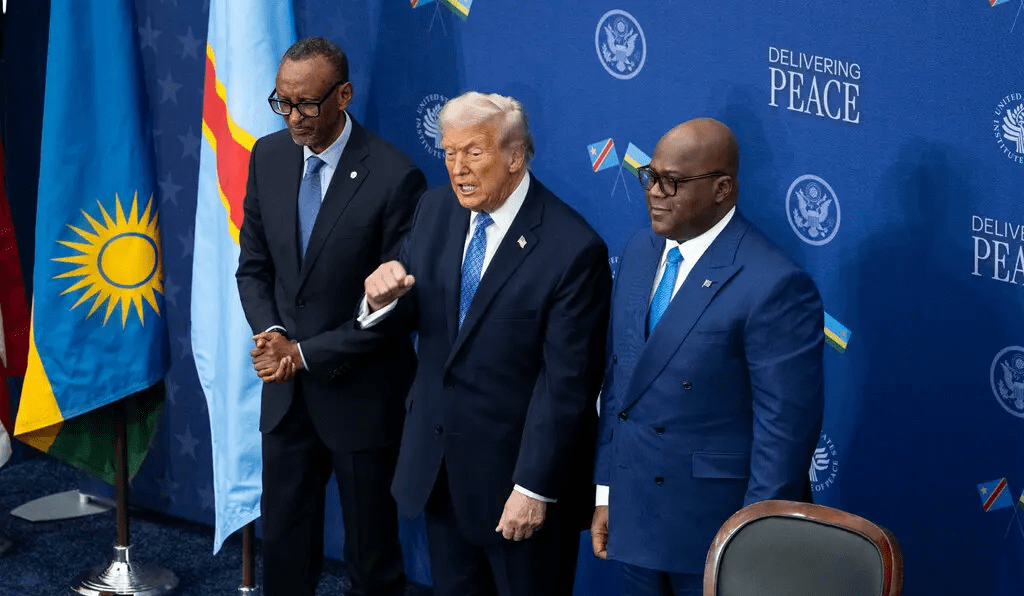
In a carefully choreographed ceremony at the newly renamed Donald J. Trump Institute of Peace, U.S. President Donald Trump on Thursday, 4 December 2025, presided over the formal signing of the long-awaited Rwanda-DRC Peace and Economic Accord – a trilateral agreement that Washington hopes will simultaneously end decades of bloodshed in eastern Congo and secure American access to the region’s vast critical-mineral wealth.
Rwandan President Paul Kagame and Democratic Republic of Congo President Félix Tshisekedi arrived separately at the Institute’s marble-columned atrium shortly after 11:00 EST. After a brief bilateral handshake captured by dozens of cameras – the first public meeting of the two leaders since January 2025 – they took their places at a mahogany table bearing the flags of the United States, Rwanda, and the DRC.
President Trump opened the proceedings with brief remarks, describing the day as “a tremendous victory for peace and a very smart deal for American industry.” He thanked both leaders for “putting aside old grievances” and pledged continued U.S. support for implementation.
The accord itself, formally titled the Washington Accords for Peace and Prosperity in the Great Lakes Region, rests on three pillars:

- Security and Ceasefire
- Immediate cessation of hostilities and withdrawal of all foreign forces from eastern DRC
- Neutralisation of armed groups, including the Democratic Forces for the Liberation of Rwanda (FDLR) and the M23 movement
- Deployment of a U.S.-supported Joint Security Coordination Mechanism (JSCM) with participation from the African Union observers
- Regional Economic Integration
- Establishment of a Great Lakes Economic Corridor linking Atlantic ports in Angola to Congolese mineral zones
- Harmonised customs procedures and joint infrastructure tenders open to American, European, and African companies
- Strategic Partnership on Critical Minerals
- Preferential exploration and development rights for U.S.-registered firms in designated cobalt, coltan, lithium, and copper zones
- Commitment to transparent revenue-sharing and anti-corruption safeguards monitored by a U.S.-DRC-Rwanda tripartite commission
The text builds directly on the ministerial framework signed in Washington on 27 June 2025 and the Doha ceasefire agreement between Kinshasa and M23 representatives on 15 November 2025.
In his measured address, President Kagame welcomed the accord as “a practical step toward durable stability,” stressing that Rwanda’s security concerns regarding the FDLR must be addressed “without ambiguity.” President Tshisekedi, speaking in French with simultaneous translation, described the agreement as “the beginning of a new chapter of sovereignty and shared prosperity,” while emphasising that mineral cooperation would be conducted “on equal terms and with full respect for Congolese law.”
Notably absent from the podium were representatives of the M23 movement, despite its central role in the conflict. U.S. officials explained that the rebels had provided written commitments to the JSCM in Doha and would be bound by the accord’s security provisions.
The ceremony concluded with the traditional exchange of signed copies and a brief reception. President Trump later posted on Truth Social: “Another war ended. Minerals secured. America First!”
Implementation begins immediately, with the first meeting of the Joint Security Coordination Mechanism scheduled for 15 January 2026 in Goma.
Despite the diplomatic achievement, heavy fighting was reported in Walikale and Masisi territories only hours before the signing, underscoring the formidable challenges that lie ahead in translating Washington ink into peace on the ground.